
The question
An independent Indie Pop artist from Nashville had spent 18 months releasing quality music but remained stuck at around 2,400 monthly listeners. Playlist pitching wasn't working. DistroKid's promotional tools had no meaningful impact. She had a strong catalogue, a real fanbase on Instagram, and consistent release cadence — but the Spotify algorithm had never noticed her. The core question: what does it actually take to get Spotify to recommend your music to new listeners?
What was tried before
What Didn't Work
- ✕Submitting to Spotify editorial through Spotify for Artists — no placements after 14 pitches
- ✕Paying for playlist placement on three third-party playlist networks — brief spike followed by listener drop-off
- ✕Running Facebook/Instagram ads pointing to Spotify profile — click-through but no listener retention
- ✕Releasing music monthly to maintain 'momentum' — catalogue grew but listener count stayed flat
Strategy applied
What We Did
- 1Identified top-performing track with highest save rate (8.1%) and stream-to-listener ratio — selected as campaign focus
- 2Ran a Chartlex Career Growth plan ($499/mo, 2025 pricing — equivalent to today's Pro Growth at $599/mo) with monthly renewals over 81 days — compounding algorithmic signals each cycle
- 3Geo-targeted US 70%, DE 15%, GB 10%, NL 5% — matching Chartlex's default CH geo distribution
- 4Monitored Spotify for Artists daily to track Radio, Autoplay, and Listener sources shifting
- 5Let the campaign compound over nearly 3 months of renewals — original target was 8,500 streams but the algorithm multiplied the effect
Observed results
The Outcome
Monthly listeners grew from ~2,400 to ~29,700 over 3 months of renewal. Total streams reached 89,000+ — a 10.5x overdelivery on the 8,500 target.
- Total streams: 89,394 delivered against an 8,500 target (10.5x overdelivery)
- Monthly listeners: ~2,400 → ~29,700 over 81 days of renewal
- Radio streams appeared at 45% of total — the dominant algorithmic source
- Discover Weekly accounted for 30% of streams, Library 20%, Daily Mix 10%
- All of this on a $499/mo Career Growth plan (2025 pricing) — 3 months of compounding
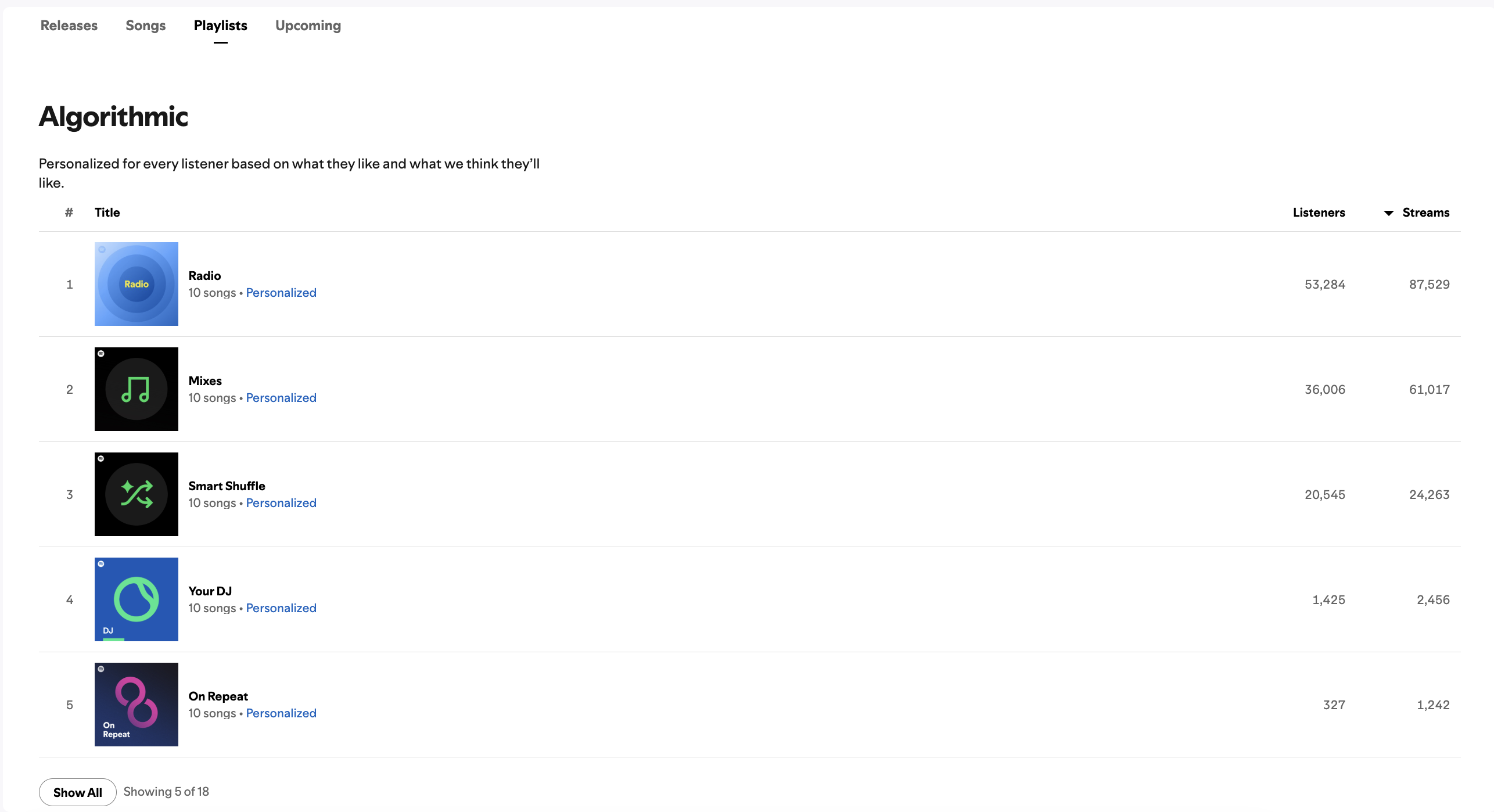
Radio and algorithmic sources after campaign activation
Why it worked
The Takeaway
Spotify's algorithm looks for threshold signals: high save rate, strong completion rate, listener-to-stream ratios that indicate genuine interest. The monthly renewal strategy was key — instead of a one-time push, the campaign kept feeding fresh algorithmic signals every cycle. By month two, Radio had become the dominant stream source at 45%, meaning Spotify's own recommendation engine was doing more work than the campaign itself. The geo distribution across US, DE, GB, and NL gave the algorithm multiple regional signals to act on. The 10.5x overdelivery proves that once algorithmic momentum is established, it compounds dramatically.
Who this applies to
Is This You?
Keep reading
Related Case Studies
My Playlist Pitching Strategy Failed Completely — Here's What Actually Worked
0 playlists → Radio + Autoplay activated within 3 weeks
How an R&B Artist Expanded From a US Fanbase to LATAM Without Releasing in Spanish
Single-market artist expanded to 12 countries in 30 days
EP vs Single: Which Release Format Gets More Algorithmic Traction on Spotify?
Single outperformed EP by 3.2x on algorithm-driven streams